Cattle / Brazil EUDR evidence

EUDR evidence for cattle from Brazil.

Brazilian cattle may move through several farms before slaughter. EUDR evidence therefore depends on the complete establishment history, not only the final supplier. Bosqio brings holding locations, forest-change evidence, land and company records, movement records and follow-up evidence into one traceable record.

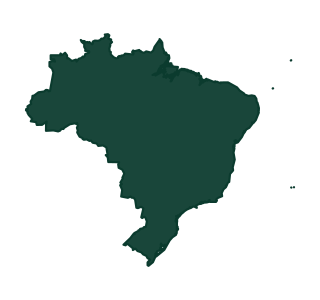
Brazil country boundary
Brazil / Cattle EUDR guide

What matters for Brazilian cattle.

Brazilian cattle due diligence depends on the complete location history of the animals, not only the final supplier. The evidence must connect the cattle to every establishment where they were kept and bring those locations together with forest-change, land, embargo, company and movement records.

Pasture maps and satellite signals provide context rather than a simple pass or fail. Grazing, rainfall, drought, fire and pasture renewal can all change how a holding looks, so conclusions depend on several dates and supporting records.

Brazil: standard risk - full due diligence still applies Animal-to-establishment traceability Forest, company and legality context
Benchmarking note

Brazil is classed as standard risk under the EU country benchmark. This is not a pass or proof of compliance for cattle from Brazil. Operators still need to collect the required information, assess risk, and follow up until any identified risk is negligible.

01 / Cattle

Brazil's cattle and pasture landscapes

Cattle production is spread across Brazil, with extensive pasture in the Amazon and Cerrado as well as long-established ranching areas elsewhere. Because animals can move between breeding, rearing and finishing farms, their location history matters as much as the final supplier. The pasture map gives regional context, but it does not replace the records for every establishment.

Pasture and forest context Animal movement history Every establishment linked
02 / Deforestation

Forest loss after 31 December 2020

Pasture expansion has long been linked to land-use change in the Amazon and Cerrado. For cattle, EUDR geolocation covers every establishment where an animal was kept, not only the final farm. Each holding therefore needs its own post-cutoff forest-loss context, with change inside the boundary kept separate from nearby alerts and older regional history.

Every establishment checked Inside-boundary change after the cutoff Nearby change as context
03 / Legality

Land, company and legality context

Animal identification and movement records, including SISBOV where applicable, help connect cattle to the places where they were kept. CAR data, IBAMA embargoes and protected or traditional territories add land and legality context. CNPJ records identify farms, traders and slaughterhouses and can be matched with official labour enforcement records. A record match needs review; the identifier alone is not evidence of wrongdoing.

Movement and establishment records CAR, embargo and territory context CNPJ and official labour records
04 / Satellite imagery

See what changed at each establishment

Bosqio helps you understand what happened on and around each establishment connected to your cattle. Bosqio's own satellite data pipeline brings the newest available observations and alerts together with historical imagery to build a clear time series. The example below shows one holding; the same evidence is important across the animal's full location history. New data, including same-day observations when available, keeps the picture current.

Newest available observations Every linked establishment Change inside or near the boundary
05 / Vegetation and radar

Pasture and radar signals over time

Pasture can change after grazing, rainfall, dry weather, fire or renewal. Vegetation indices show how plant cover changes over time, while Sentinel-1 radar adds information through clouds. Together, the signals help separate a normal pasture cycle from a lasting clearing or conversion.

Pasture patterns over time Radar context under clouds Normal cycles kept in context
06 / Spatial change

Pasture change in context

Not every change in a pasture signal is deforestation. Grazing, pasture renewal, drought, fire and image noise can all change what appears on the map. The strongest clues are where the change sits relative to the holding, when it began and whether it remains visible in later observations.

Location relative to the holding Timing and persistence Movement records where needed