Cocoa / Brazil EUDR evidence

EUDR evidence for cocoa from Brazil.

Brazilian cocoa evidence can cross very different production landscapes, including agroforestry, smallholder systems, forest mosaics, and legally sensitive areas. Bosqio structures those signals into one EUDR evidence workflow: plot geolocation, remote-sensing checks, cocoa production context, local legality layers, producer evidence, and report-ready outputs.

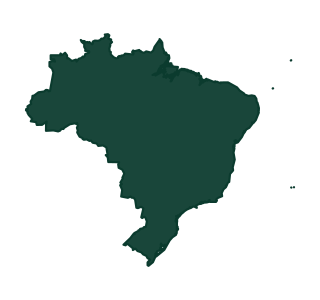
Brazil country boundary
Brazil / Cocoa coverage module

How Bosqio helps you with EUDR for Brazilian cocoa.

Use the Brazil cocoa module to see where your plot sits before you open the evidence file: which country layers matter, which producer evidence may be needed, and which signals deserve follow-up before a DDS decision is prepared.

The maps below are only the overview. At plot level, Bosqio can also combine remote-sensing baselines, spectral time-series checks, and change-detection methods such as CCDC-style breakpoint analysis to show where land-cover changes need closer review.

EU benchmark: standard-risk origin Cocoa map context Brazil legality context
Benchmarking note

Brazil is not listed in the EU high-risk countries in the Commission's 2025 country benchmarking annex. Under Article 29, countries that are not classified as low or high risk fall into the standard-risk category.

01 / Baseline

Brazil-wide baseline and commodity footprint

The first map combines the JRC 2020 forest baseline with MapBiomas commodity-area context across EUDR-relevant production in Brazil. For cocoa, this shows whether a submitted plot sits inside forest baseline, established non-forest, or a wider production landscape before the farm record is reviewed.

JRC 2020 forest baseline MapBiomas commodity footprint Plot context before farm review
02 / Deforestation

Forest-loss screening after the cutoff

The deforestation map separates historical land-use change from forest loss after the EUDR cutoff. For each cocoa evidence record, Bosqio can compare the submitted boundary against post-2020 forest-loss signals and show whether a concern is inside the plot, nearby, or part of older regional context.

Post-2020 forest-loss screening Historic 2011-2020 context Overlap and proximity review
03 / Cocoa

Cocoa production and forest context

The cocoa layer helps you compare submitted plots with mapped cocoa areas and nearby forest baseline. This matters because Brazilian cocoa can appear in very different production systems, from agroforestry and smallholder plots to more open production landscapes, so the remote-sensing result needs commodity context before review.

Mapped cocoa areas Agroforestry and smallholder context Cocoa-specific plot review
04 / Legality

Legality layers and sensitive areas

The legality map brings together Brazilian layers that can change what evidence is needed: Indigenous territories, conservation units, Quilombola territories, undesignated public forests, embargo areas, the Atlantic Forest Law zone and the Legal Amazon boundary. If a plot intersects or sits close to one of these layers, the workflow can ask for supporting documents instead of leaving the alert unexplained.

Embargo and territory context Protected, traditional and public land layers Document follow-up where needed